Film Study
Entertaining Dadaist experimental short, similar to Man Ray’s work, full of shifting geometric shapes, stock footage of seagulls, flying eyeballs, and glaring floating heads.
In 1926, cinema was still largely wrestling with whether it was an offshoot of theater or a novel way to tell traditional stories. Hans Richter, fresh off his radical Rhythmus experiments (Rhythmus 21, 23), had a vastly different proposition: film as pure, kinetic painting—a medium freed from narrative servitude and driven solely by tempo, light, and unconscious association. Filmstudie marks the pivotal moment where Richter transitioned from pure geometric abstraction into surreal, figurative dreamscapes, creating what remains one of the most hypnotic and poetically jarring short films of the silent era.
The Eye as Canvas and Spectacle
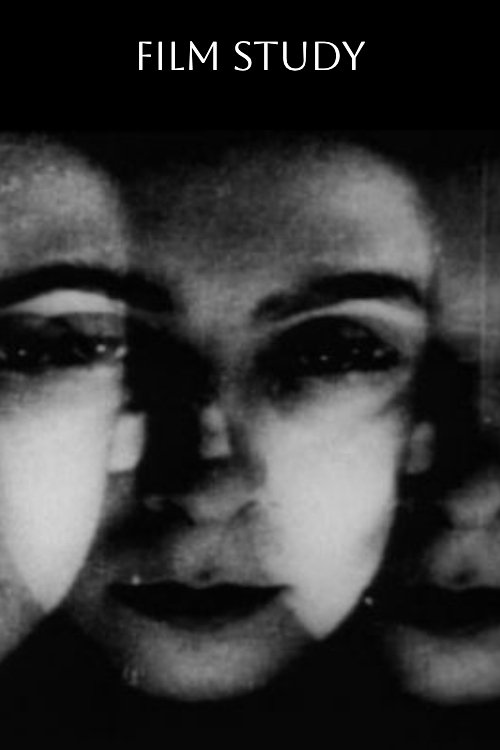
Spanning less than five minutes, Filmstudie opens with undulating light forms before unleashing its most famous and enduring visual motifs: disembodied, floating eyeballs staring directly at the audience, fractured prisms, and multiplying portrait head (most notably the serene face of avant-garde photographer Stella F. Simon).
Richter treats the camera lens not as an objective recorder of reality, but as a hallucinatory organ. Through an inventive barrage of superimpositions, inverted negative exposures, jump cuts, and kaleidoscopic lens distortions, ordinary human features dissolve into pure geometric rhythms. An eye morphs into an abstract sphere; a face is swallowed by shadow; geometric lines rhythmically slice across the frame. By making the human eye both the subject of the film and its primary metaphor, Richter playfully confronts the viewer with the act of seeing itself.
Rhythm over Reason
What makes Filmstudie feel remarkably modern—even a century later—is Richter’s mastery of montage[6]. While his French contemporaries like Man Ray (Emak-Bakia) and Fernand Léger (Ballet Mécanique) were pursuing similar Dadaist ruptures, Richter brought a distinct musicality to the editing bench. Every cut feels syncopated; images bounce, accelerate, decelerate, and echo back on themselves like visual counterpoint (it is no coincidence that Paul Hindemith composed music for its early showings). The logic is entirely oneiric—the subconscious associative flow of a dream where cause and effect are replaced by visual rhyme and rhythmic pulse.
True to Richter’s Dadaist humor, the feverish visual assault terminates abruptly with a blunt intertitle: “AUS” (Off or Out). In a split second, the hypnotic trance is snapped, leaving the spectator blinking in the dark.
Final Verdict
Filmstudie is a pocket-sized masterpiece of silent avant-garde cinema. It serves as a vital historical bridge connecting the absolute animation of 1920s Weimar Germany with the surrealist revolutions of Salvador Dalí and Luis Buñuel, and later, the mid-century American avant-garde of Maya Deren. For anyone fascinated by the outer limits of film grammar, montage theory, or the primal power of the moving image, Hans Richter’s four-minute visual poem remains essential viewing.